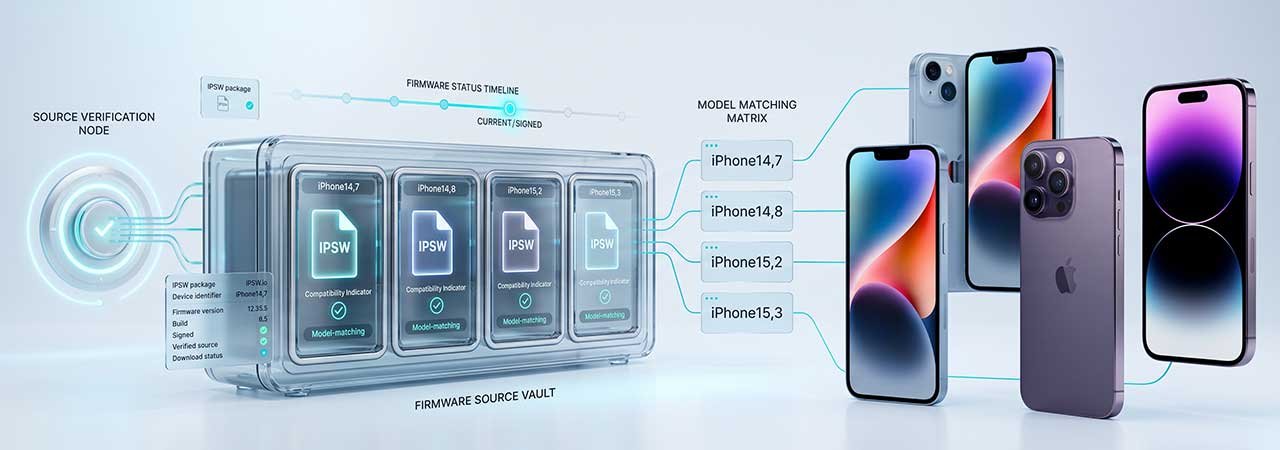
If you're searching "iPhone 14 flash file" you're most likely coming from Android, where flashing a device means writing a ROM or partition image with a tool like Odin or SP Flash Tool. iPhone doesn't have a direct equivalent of that file or that process. What you actually want is the IPSW for your exact iPhone 14 model — and the process to use it is called a restore, not a flash. This page explains what's different and gets you to the right file.
For what "flash file" means as a term and how the concept maps across platforms in general, see the iPhone Flash File explainer. This page covers what's specific to the iPhone 14.
iPhone 14 Identifiers — Which File You Actually Need
| Model | Identifier | Download |
|---|---|---|
| iPhone 14 | iPhone14,7 | iPhone14,7 IPSW files |
| iPhone 14 Plus | iPhone14,8 | iPhone14,8 IPSW files |
| iPhone 14 Pro | iPhone15,2 | iPhone15,2 IPSW files |
| iPhone 14 Pro Max | iPhone15,3 | iPhone15,3 IPSW files |
Watch the identifier prefix here — it's a common mix-up. The Pro and Pro Max jump to an iPhone15,x prefix instead of continuing iPhone14,x, because they use a different chip generation. For full identifier details, current signed builds, and restore steps, see the iPhone 14 Firmware guide.
What Android "Flashing" Habits Get Wrong on iPhone
If you've flashed an Android phone before, a few assumptions carry over that don't apply here:
There's no partition-level flashing
On Android, tools like Odin write individual partitions — boot, recovery, system — separately, and you can often flash just one. An IPSW restore on iPhone 14 replaces the entire firmware image as one atomic operation through Finder, the Apple Devices app, or iTunes. There's no equivalent of flashing "just the boot partition."
The file must be signed by Apple, checked live
Android ROMs, once downloaded, generally install regardless of what the manufacturer's servers say at that moment. An iPhone 14 restore checks with Apple's servers during the process and will only proceed if that specific build is currently signed for that specific identifier. Apple signs only the current build at any given time — a file that worked for someone else last month can fail for you today if Apple has since stopped signing it.
There's no custom recovery
Android has TWRP and similar custom recovery partitions that accept arbitrary flashable zips. iPhone 14's Recovery Mode and DFU Mode are Apple-controlled states used only to accept a signed IPSW through official restore software — neither is a general-purpose flashing environment.
You can't arbitrarily downgrade
Flashing an older Android ROM is usually just a matter of finding the file. On iPhone 14, downgrading only works if Apple is still signing the older build, which is uncommon and temporary. Check current signing status before assuming a downgrade is possible.
How to Restore an iPhone 14 (Any Variant)
Back up your device, turn off Find My (Settings → your name → Find My → Find My iPhone), connect with a Lightning cable, and in Finder, the Apple Devices app, or iTunes hold Option (Mac) or Shift (Windows) and click Restore, then select the IPSW matching your exact identifier from the table above. If the device is unresponsive, use Recovery Mode first. For the complete step-by-step process and troubleshooting, see the iPhone 14 Firmware guide.
You can also browse every iPhone model from the iPhone firmware page.
iPhone 14 Flash File FAQ
Is there an iPhone 14 flash file like there is for Android?
Not in the same sense. The closest equivalent is the IPSW file for your exact identifier (iPhone14,7/14,8/15,2/15,3), but the restore process works differently — whole-firmware only, signed and verified live by Apple, no partition-level flashing.
Can I flash just one part of my iPhone 14, like Android's partition flashing?
No. An IPSW restore replaces the entire firmware image as one operation. There's no tool or method that flashes an individual partition on iPhone.
Why is the iPhone 14 Pro identifier iPhone15,2 instead of iPhone14-something?
The Pro and Pro Max use a different chip generation than the standard iPhone 14 and iPhone 14 Plus, so Apple assigned them the iPhone15,x prefix instead of continuing iPhone14,x. All four are still "iPhone 14" models by marketing name.
Do I need a custom recovery to flash my iPhone 14?
No. iPhone 14 has no custom recovery equivalent. Recovery Mode and DFU Mode are Apple-controlled states for restoring signed IPSW files only, not general-purpose flashing tools.
Can I downgrade my iPhone 14 by flashing an older file?
Only if Apple is still signing that older build, which is typically a narrow and temporary window. This is different from Android, where older ROMs usually remain flashable indefinitely.


